Most fire reporting software was built for big career departments and handed down to everyone else. The fields don't match the call, half the form is irrelevant to the incident in front of you, and the part you dread is the paperwork afterward. 911 Analytics was built the other way around, by volunteer firefighters, so the run report bends to the incident instead of the other way around.
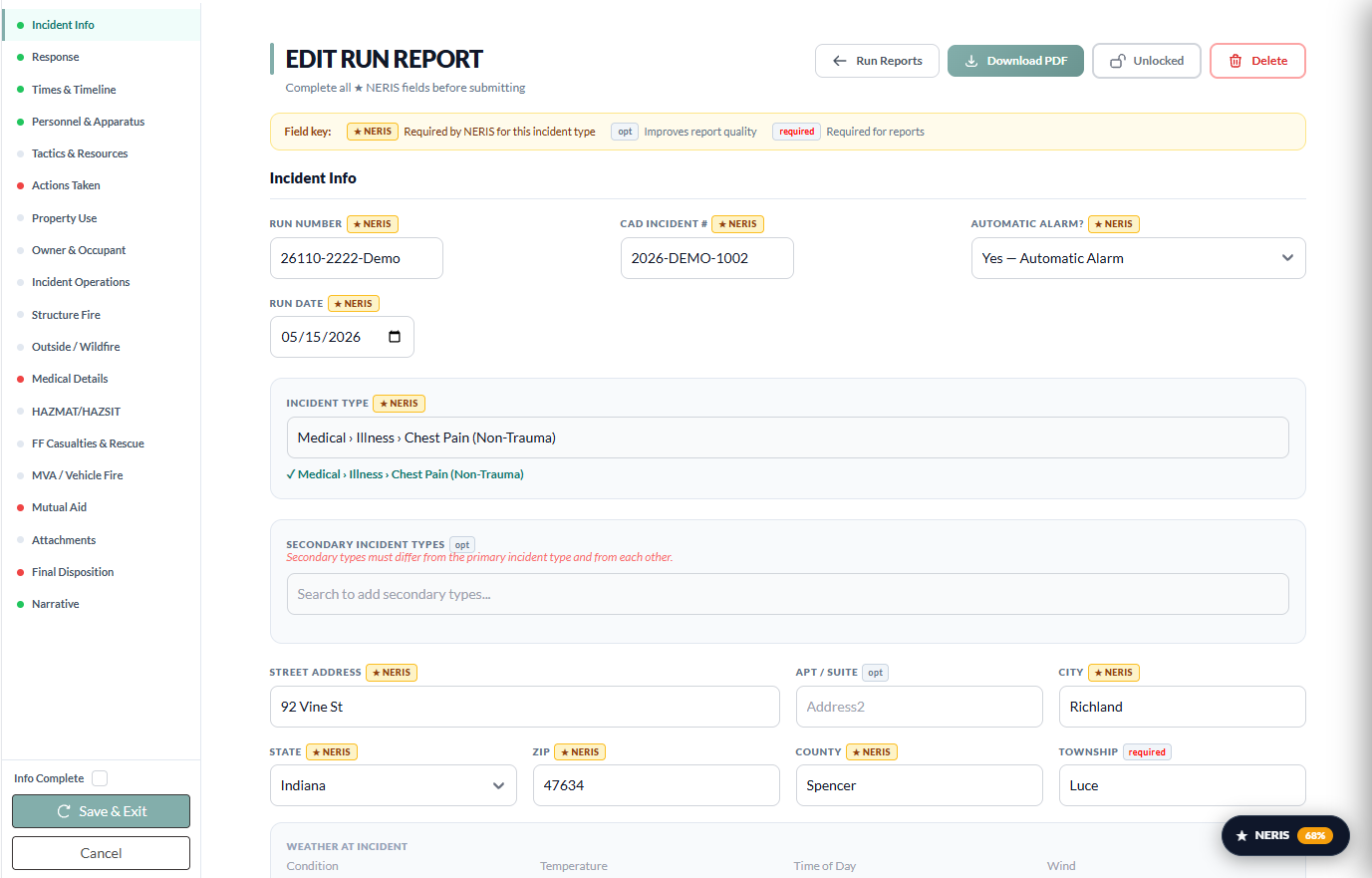
One report, every discipline
A single run report adapts to what actually happened. Pick the incident type and the report surfaces the right sections — and hides the ones that don't apply:
- Structure and outside/wildland fire, with origin, cause, and damage detail
- EMS and medical, with patient care evaluation and disposition
- Hazardous situations, including chemical, electrical, and power-generation hazards
- Motor vehicle collisions and extrication, with per-vehicle and occupant detail
- Firefighter casualty and rescue documentation
- Mutual aid given and received
Live NERIS readiness as you type
A readiness panel tracks completion in real time, showing a running percentage and exactly which required fields remain for this specific incident type. Each section gets a green or red status dot, so a member always knows what's left before a report can be submitted to NERIS. No more discovering missing fields at submission time — the report tells you as you go.
Auto-draft narratives
The narrative writes its first draft from the structured data you've already entered — units, conditions on arrival, actions taken, command, and disposition — including a medical summary when patient records exist. The crew edits instead of starting from a blank box, which is the difference between reports that get finished and reports that sit half-done for a week.
Capture the response, not just the paperwork. Run reports tie into a live response view — apparatus GPS, responding personnel, hydrants, and pre-plan data on one map — so the record reflects what happened on scene, captured as it happened rather than reconstructed from memory.
It all connects
Run reports feed the rest of the platform automatically: your ISO/FSRS rating estimate, response-time analytics, personnel activity and points, and apparatus usage all draw from the same records. Document the incident once and it flows everywhere it's needed — and submits to NERIS in one click. Flat pricing, no per-seat fees, built for volunteer and combination departments.