Your ISO Public Protection Classification (PPC) affects property insurance premiums across the community you protect — and for most volunteer departments, it's a black box that only opens every several years when ISO shows up to evaluate. 911 Analytics turns it into something you can see and work on continuously, by estimating your FSRS score from the data your department already generates.
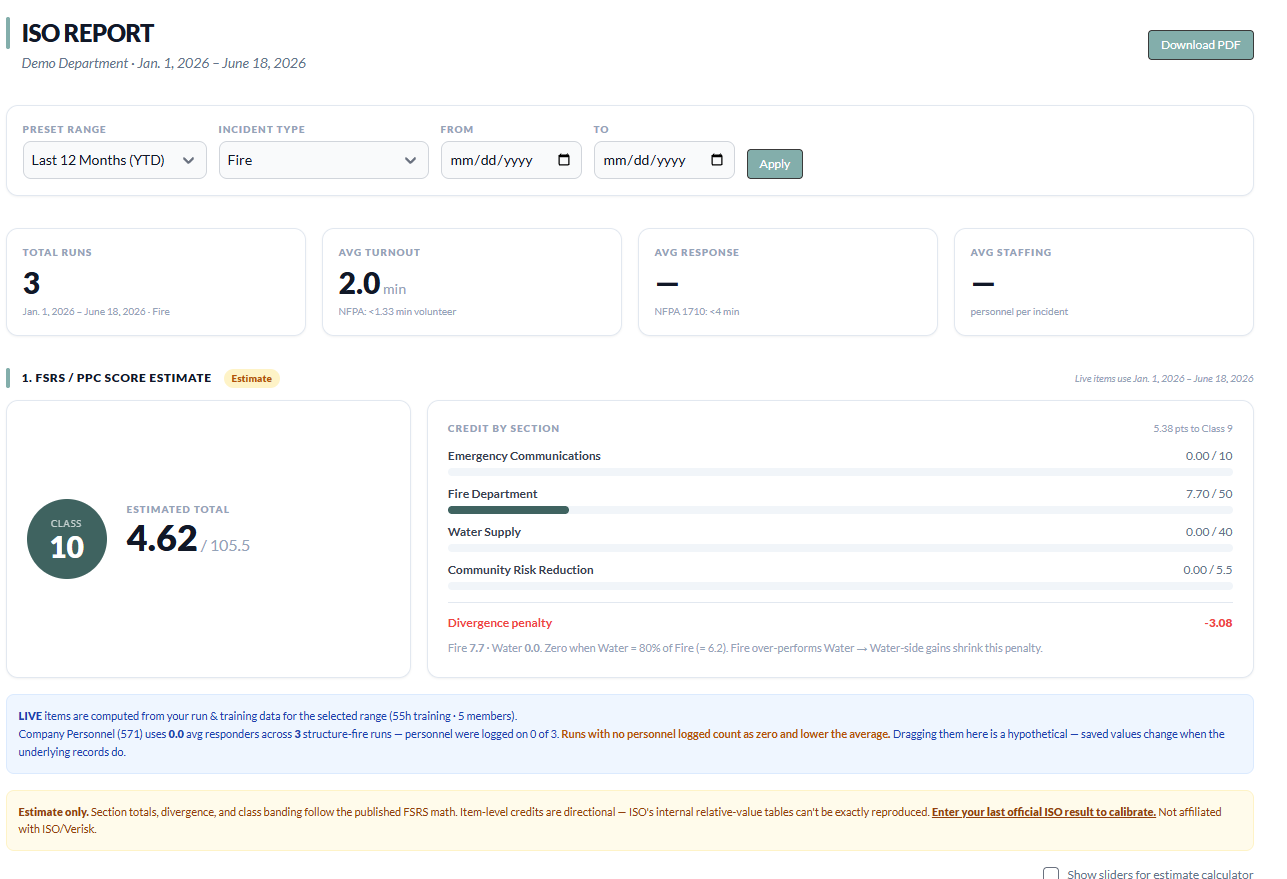
An estimated class, computed from live data
The report produces an estimated total score and PPC class, broken out by the four FSRS sections: Emergency Communications, Fire Department, Water Supply, and Community Risk Reduction. Each section's credit is derived from your actual records — runs, response times, training hours, staffing, apparatus, and hydrant flow — so the estimate reflects your real operation, not a questionnaire.
- Estimated total score and class band, following the published FSRS math
- Credit by section with the points available in each
- Divergence penalty modeled, so the estimate tracks how ISO balances fire and water capability
- Calibrate against your last official ISO result for a closer estimate
See the gap, then close it
The real value isn't the number — it's seeing where the points are. When the report shows water supply credit sitting at zero while fire department credit climbs, that's a concrete, fixable target. Because the items are computed live, fixing the underlying records — logging personnel on every run, recording training hours, documenting hydrant flows — moves the estimate in real time. It turns ISO improvement from a once-a-decade scramble into an ongoing, visible process.
An estimate, honestly labeled. Section totals, divergence, and class banding follow the published FSRS schedule. Item-level credits are directional — ISO's internal relative-value tables can't be exactly reproduced, and 911 Analytics isn't affiliated with ISO or Verisk. It's a planning tool to find and close gaps before the official evaluation, not a substitute for it.
NFPA benchmarks alongside your numbers
Response and staffing figures display against NFPA benchmarks — turnout time, response time, and personnel-per-incident — so you can see at a glance where your department stands against the standards that inform both ISO and your own operational goals. Export the whole thing to PDF for board presentations, grant applications, or your own records.
Built into the platform, not bolted on
Because the ISO report draws from the same data as your run reports, apparatus records, and hydrant management, there's nothing separate to maintain. Document your incidents and inspections the way you already do, and the rating tool stays current automatically. It's one piece of a complete platform built by volunteer firefighters for volunteer and combination departments — at flat pricing, with no per-seat fees.